Weather Radios
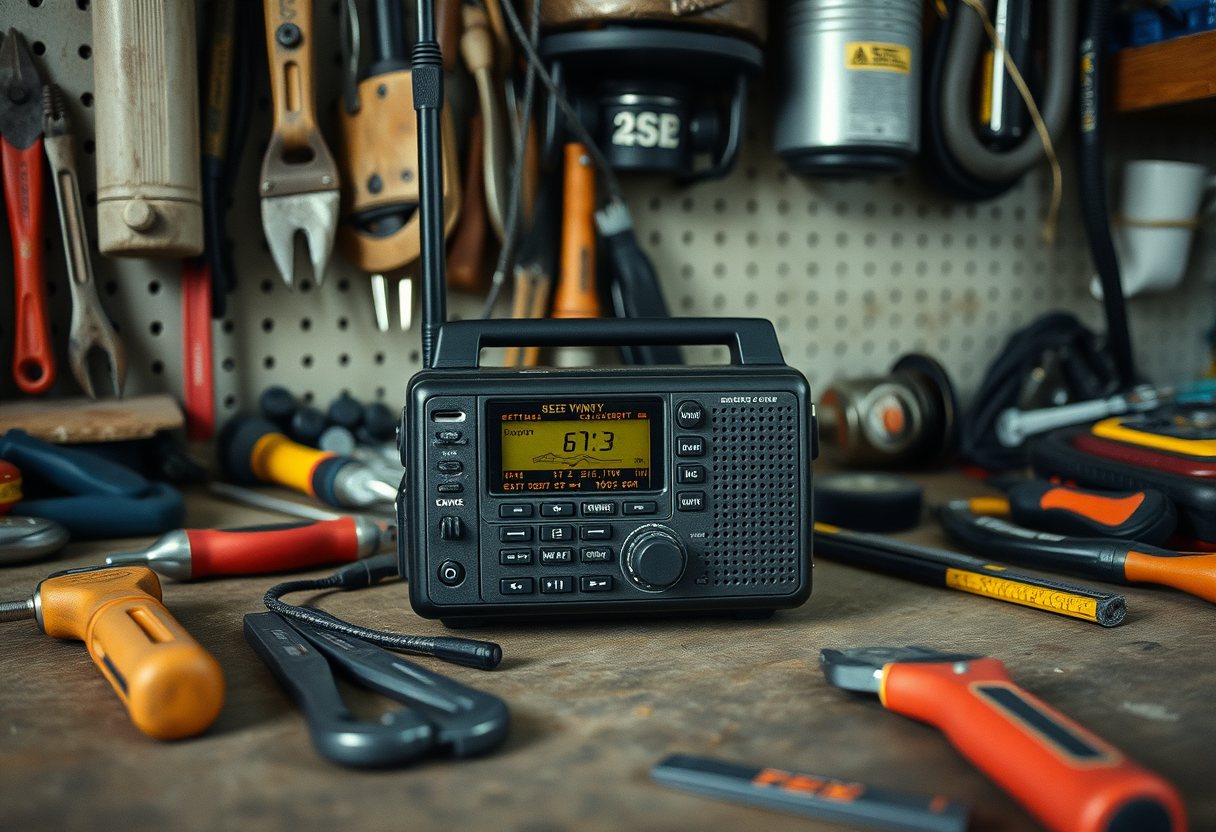
Illustrative photo of this kind of gear — the official product photo loads via Amazon.
Midland XT511 Emergency Base Camp Radio
See price on Amazon
Live Amazon pricing connects soon — confirm today's price on Amazon.
As an Amazon Associate I earn from qualifying purchases.
Photo gallery
loads via Amazon API📷
Photo gallery
loads via Amazon API📷
Photo gallery
loads via Amazon API
A two-way radio wearing an emergency radio's clothes
The Midland XT511 flips the usual formula: instead of an emergency radio with extras, it's a GMRS two-way radio with an emergency radio built around it. Twenty-two GMRS/FRS channels for talking to your group, plus ten NOAA weather channels with alert, AM/FM radio, a hand crank, and USB phone charging. For a family camp, a neighborhood emergency plan, or a convoy on the road, the ability to both hear warnings and talk to your people is the whole point.
Talk first, then listen
The two-way side offers 22 GMRS/FRS channels with 121 privacy codes (38 CTCSS plus 83 DCS — 2,662 channel combinations), high/low power settings, channel scan, dual watch, hands-free eVOX with three sensitivity levels, 10 call alerts, keypad lock, and roger beep. Midland advertises a maximum range of up to 40 miles — treat that as the manufacturer best-case figure, meaning unobstructed line-of-sight like mountaintop to mountaintop. Realistic handheld UHF range is typically one to three miles in suburbs or woods, stretching further across open terrain. On transmit power, sources conflict: Midland's official owner's manual lists up to 2W, while several retailers advertise 5W — worth confirming against the unit's FCC ID if the number matters to you.
The receive side covers AM/FM on an analog band switch with tuning knob, ten NOAA weather channels with an alert mode that auto-activates the radio on incoming warnings, a backlit LCD display, and an alarm clock with snooze. Note there's no S.A.M.E. county-code filtering here — alerts are tone-based, not location-coded.
Base-camp power and the license box
Power comes five ways: four AA alkalines, the included NiMH rechargeable pack, the dynamo hand crank, the included AC wall adapter, or a DC adapter. A USB port provides emergency cell-phone charging (Midland doesn't publish the output amperage, so expect a top-up). Extras include a 3-LED flashlight, water resistance, mic and headphone jacks, and an accessory hand mic plus shoulder strap in the box. It's a substantial unit at 7.25 × 6.38 × 2.75 inches and about 1.2 pounds per retailer figures.
Important — the FCC license: transmitting on GMRS frequencies legally requires an FCC license in the United States. The good news: there's no test. You apply through the FCC's Universal Licensing System (Form 605), pay the current fee (about $35), and the license lasts ten years and covers your immediate family members operating under it. Listening — NOAA, AM/FM, and receiving on any channel — needs no license at all. The lowest-power FRS channels (8–14) are license-free, but operating this radio at its higher power levels means getting the GMRS license first.
Who it's for, and who should skip it
The XT511 fits group scenarios: family camping, neighborhood emergency communications, road convoys, or a base camp coordinating with handhelds in the field. If your plan involves talking to people, not just hearing alerts, nothing else in this lineup does that.
Skip it if you only need weather alerts — the license requirement and complexity are overkill, and the Midland WR400 is simpler and cheaper. And if county-coded S.A.M.E. filtering is essential, look at the WR400 or Sangean CL-100 instead.
Pros
- True GMRS two-way: 22 channels, 121 privacy codes, eVOX hands-free
- 10 NOAA weather channels with auto-activating alert mode
- Five power sources including hand crank and included NiMH pack
- USB emergency phone charging; 3-LED flashlight
- Hand mic and shoulder strap included; 3-year warranty on unit and mic per catalog
Cons
- FCC license required to transmit on GMRS (no test, but a required step)
- No S.A.M.E. county-code filtering — alerts are tone-based
- Analog tuning for AM/FM feels dated next to digital rivals
- Transmit wattage figures conflict between Midland's manual (2W) and retailers (5W)
- Bulky at 7.25 inches tall — a base station, not a pocket radio
Specs
| Spec | Detail |
|---|---|
| Two-way | GMRS/FRS, 22 channels, 121 privacy codes (38 CTCSS / 83 DCS) |
| Transmit power | HI/LO settings; official manual lists up to 2W (retailers list 5W — unconfirmed) |
| Range | Up to 40 miles per Midland (line-of-sight best case; expect 1–3 miles typical) |
| Radio bands | AM, FM, 10 NOAA weather channels |
| Alerts | NOAA weather alert (auto-activate); S.A.M.E. not listed |
| Power | 4x AA alkaline, NiMH pack (included), hand crank, AC adapter (included), DC adapter |
| Phone charging | Yes, USB output (amperage unpublished) |
| Flashlight | 3-LED flashlight |
| Extras | Hand mic + shoulder strap included, alarm clock with snooze, channel scan, dual watch, eVOX |
| Durability | Water resistant |
| Size / weight | 7.25 x 6.38 x 2.75 in; ~1.2 lb (retailer figure) |
| License | FCC GMRS license required to transmit (no exam; ~$35; 10-year term; covers family) |
| Best for | Group camps and neighborhood emergency communications |
Frequently asked questions
Do I really need an FCC license? To transmit on GMRS channels, yes — it's the law. There's no exam: apply via the FCC Universal Licensing System (Form 605), pay about $35, and you're licensed for ten years with coverage for immediate family members. Listening to NOAA, AM/FM, or any channel requires no license.
What's the realistic range? Midland's "up to 40 miles" is a best-case, line-of-sight figure. Expect one to three miles between handhelds in suburbs or woods, more across open water or flat terrain. Height and clear line of sight matter more than wattage.
Can it charge my phone? Yes, there's a USB output for emergency top-ups. Midland doesn't publish the amperage, so plan on a slow charge.
Why not just use the FRS channels without a license? Channels 8–14 are indeed license-free FRS channels, but this radio's higher power settings are GMRS operation, which needs the license. Given the license is cheap, test-free, and lasts a decade, it's the straightforward path.
Verdict
The XT511 is the only radio here that talks back: real GMRS two-way capability wrapped around NOAA alerts, a crank, and phone charging. The FCC license is a genuine prerequisite — no test, modest fee, ten years — so factor in that one errand. If your emergency plan includes communicating with your group, this is the base camp to build it on. Check the current price on Amazon: View on Amazon
As an Amazon Associate I earn from qualifying purchases.
Video review
Our video review for this product is in production — check back soon.
Rate this product
Own it or researched it? Give it a star rating — it helps other readers.
Reader comments & questions
Ask a question or share your experience with this gear.
Leave a comment
Was this review helpful?
Share this review:
You may also like
Midland ER310 Emergency Weather Radio
Hand crank, solar, NOAA alerts, flashlight, and phone charging in one rugged unit.
Midland ER310 Pro Emergency Radio
The ER310 upgraded: Bluetooth streaming plus a 10,000 mAh power bank.
Midland WR120 NOAA Weather Alert Radio
S.A.M.E. localized alerts for your county — the set-it-and-forget-it home option.
Loading comments…