Survival Kits
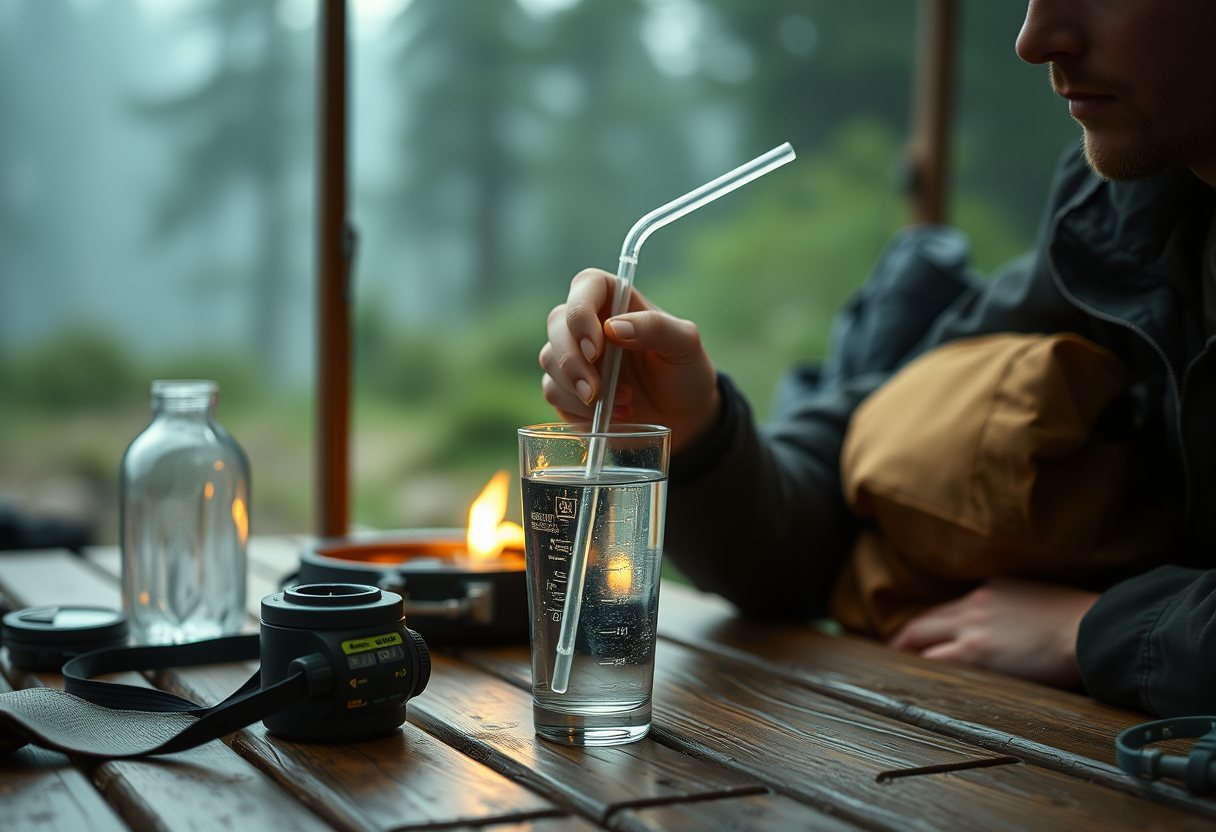
Illustrative photo of this kind of gear — the official product photo loads via Amazon.
LifeStraw Personal Water Filter
See price on Amazon
Live Amazon pricing connects soon — confirm today's price on Amazon.
As an Amazon Associate I earn from qualifying purchases.
Photo gallery
loads via Amazon API📷
Photo gallery
loads via Amazon API📷
Photo gallery
loads via Amazon API
Water is the first problem
Shelter and food can wait. Water cannot, and stored water runs out faster than people expect: a person needs roughly a gallon a day including drinking and basic hygiene, so a two-case stash in the garage is a few days for one person and barely a weekend for a family. The gap between "the case is empty" and "the taps work again" is what a filter has to fill, and the LifeStraw Personal Water Filter is the smallest, most widely carried way to fill it. It is a straw: you put one end in the water and drink through the other, and the filter inside does the work.
What makes it worth owning rather than merely interesting is the arithmetic. LifeStraw rates the membrane inside this straw for up to 1,000 gallons — 4,000 litres — which the manufacturer describes as more than five years of drinking water for one person. The filter has no shelf life and no expiry date, it needs no electricity, no chemicals, no pumping and no priming, and it weighs 46 grams. Very few items in a preparedness kit deliver that much capability per ounce.
How it works
The filter is a hollow-fibre membrane microfilter with a pore size of 0.2 microns, and the mechanism is mechanical rather than chemical: water is pulled through the membrane, and anything physically larger than the pores is trapped on the dirty side. On the manufacturer's independently lab-tested spec sheet, that removes 99.999999% of bacteria, 99.999% of parasites, and 99.999% of microplastics, along with dirt, sand and the cloudiness that makes questionable water look undrinkable. The straw meets US EPA and NSF P231 drinking water standards for bacterial and parasitic removal. That covers the things that make people seriously ill from untreated surface water: E. coli, Giardia, Cryptosporidium, and the rest of that family.
Just as important is what it does not do. LifeStraw's own specification lists bacteria, parasites and microplastics — not viruses. Viruses are small enough to pass a 0.2 micron membrane, which is why virus removal requires a different technology: purification, whether that is UV, chemical treatment or a filter designed for it. Nor does this straw remove dissolved contaminants — salt, heavy metals, agricultural chemicals or industrial pollution all travel straight through. If the water in front of you is seawater, or sitting next to a chemical spill, this filter is not the answer. It is for fresh water that might contain pathogens, which is the situation in the overwhelming majority of real emergencies.
Using it takes a moment of practice. You uncap the mouthpiece, put the other end in the water, and drink through it with normal suction — the flow rate is easy, if not a mouthful per stroke, and it gets slower as the filter loads up. You drink directly from the source rather than filling a bottle, so you filter as you go: fine for a stream, less convenient for a bucket of stored water. Cleaning is straightforward: backflush by blowing air back through the straw, and use the provided instructions for a vinegar-based deep clean if the flow slows noticeably. The straw is supplied with a lanyard and a user manual, and it wants to be stored dry, which the carry design and caps accommodate.
Who it's for, and who should skip it
Buy it if you want personal, always-carried water insurance. Hikers, backpackers, travellers and bikepackers are the obvious audience, and the straw format is exactly right for them: no bottle to carry, no clean reservoir slowly getting manky, no waiting for tablets to dissolve. It is also the item in a bug-out bag that weighs almost nothing and can be handed to a person who has nothing else — put one in each family member's bag, because a group with one filter among five people is a group with a bottleneck.
Skip it if you have to filter for other people or produce stored water at a base. The personal straw is a one-person, drink-as-you-go device; if you need to fill bottles and containers for a household, a gravity filter or a pump filter will do the job with far less work, and a household-scale purifier is the right tool for anything requiring virus removal. The straw also demands suction, which is a genuine limitation for children, older people and anyone who is ill or exhausted — the people most likely to need clean water. If that describes your household, buy a gravity system instead and keep the straws as backups and spares.
Skip it as well if your plan is a few days of stored water in a settled area. Filtering is what you need when stored water runs out or when you have to leave. If your actual risk is a two-day storm outage, extra cases of bottled water and a filled bathtub will serve you better than a filter you may never unwrap. The LifeStraw earns its place when the situation is bad enough that you are collecting water from outside — which is precisely why it is worth having even if you hope never to use it.
Pros
- Filters up to 1,000 gallons / 4,000 litres per straw, which the maker rates at 5+ years for one person
- Removes 99.999999% of bacteria and 99.999% of parasites on independently lab-tested figures
- No chemicals, no batteries, no pumping and no shelf life — it works after years in a drawer
- Weighs about 1.6 oz / 46 g and needs no bottle, so it fits in any pocket or bag
- Meets US EPA and NSF P231 standards for bacteria and parasite removal
- You drink straight from the source, so there is no reservoir to keep clean
Cons
- Does not remove viruses — that requires purification, not mechanical filtration
- Does not remove salt or dissolved chemicals, so it cannot make seawater or polluted water safe
- One person, drink-as-you-go use only; it will not fill containers for a household
- Needs suction, which is hard work for children, older or unwell users
- Flow slows as the filter loads, so it needs backflushing to stay fast
Specs
Verified from the maker's own listings, manuals and product pages; anything we could not confirm we have left out rather than guess at.
| Spec | Detail |
|---|---|
| Brand / model | LifeStraw Personal Water Filter (straw, 1-pack) |
| Filter type | Hollow-fibre membrane microfilter, 0.2 micron pore size |
| Removes | 99.999999% of bacteria, 99.999% of parasites, 99.999% of microplastics, dirt and sand |
| Does not remove | Viruses, salt or dissolved chemicals |
| Capacity | Up to 1,000 gallons / 4,000 litres per filter (about 5 years of drinking water for one person) |
| Shelf life | None — store it dry and it keeps indefinitely |
| Dimensions / weight | 9 x 1.2 in (22.9 x 2.5 cm); 1.6 oz (46 g) |
| Standards | Meets US EPA and NSF P231 drinking water standards for bacteria and parasites |
| Materials | BPA-free; no iodine or other chemicals used |
| In the box | LifeStraw filter, lanyard, user manual |
| Best for | Hiking, travel, and drinking from surface water when stored supplies run out |
Frequently asked questions
Will it make any water safe to drink? No, and that distinction matters. It removes bacteria, parasites and microplastics from fresh water, which covers most emergency situations. It does not remove viruses, salt or dissolved chemicals, so seawater, brackish water and water contaminated by industrial or agricultural chemicals are still unsafe after passing through the straw.
How do I know when it is used up? The rated life is 1,000 gallons or 4,000 litres, which is far beyond what a household will use in normal emergencies. In practice the filter announces itself by getting harder to drink through: when flow drops, backflush it, and follow the manufacturer's cleaning instructions before deciding it is spent.
Can children use it? Physically, yes, but the straw needs real suction and the flow is moderate, so younger children and anyone who is tired or unwell will struggle. If your household includes people who cannot drink through a straw easily, plan on a gravity or pump filter for them and keep the LifeStraw as a personal backup.
Do I need to store it a particular way? Keep it dry, with the caps on, at ordinary room temperature. There is no expiry and no liquid to leak. The one habit worth keeping is a quick test sip at the start of each season so you know it flows before you are relying on it.
Verdict
The LifeStraw Personal Water Filter is the best value-per-ounce item in most emergency kits. It weighs nothing, keeps forever, needs no chemicals or power, and turns a stream into drinking water for one person for years. Understand its limits — no viruses, no salt, one mouth at a time — and pair it with a household-scale filter or purifier if you are covering more than yourself. View on Amazon
Video review
Watch it in action before you buy.
Video: “I Tested LifeStraw in the Worst Conditions – Here's What Happened” by Handy Homestead Reviews on YouTube.
Rate this product
Own it or researched it? Give it a star rating — it helps other readers.
Reader comments & questions
Ask a question or share your experience with this gear.
Leave a comment
Was this review helpful?
Share this review:
You may also like
First My Family 4 Person 72 Hour Bug Out Bag with LifeStraw Go
A four-person bug-out bag that includes a LifeStraw Go bottle already packed in.
Redfora Complete Earthquake Bag
A comprehensive earthquake kit with the basics already assembled for a household.
Stealth Angel 72-Hour Survival Kit
A ready-made 72-hour kit for one person, including food, water and shelter basics.
Loading comments…